New Jersey State Budget Comparison 2008 vs 2009
The following is a comparison of Governor Corzine’s 2008 vs. 2009 state budget by revenue source and expenditure by budget area.
 Data Source: New Jersey Department of the Treasury – Office of Management and Budget
2008 New Jersey State Budget
2009 New Jersey State Budget
Update: The 2009 budget proposes $334 million be set aside as a "long-term obligations and capital expenditure fund". In other words, Governor Corzine is proposing no reduction in state spending as compared to his 2008 budget proposal. However, the Governor’s 2009 budget proposal is $177.9 million leas than 2008’s adjusted appropriations of $33,470,900,000.
Labels: Jon Corzine, New Jersey, State Budget, State Budget 2009
Posted by Enlighten-NewJersey @ 3:14 PM
|


New Jersey Taxpayer Education Tour – Part 2
This year, the state’s income tax will generate $12.4 billion - more than all other state taxes, fees and revenue sources combined, with the exception of the state’s sales tax. The sales tax will bring in $8.8 billion and everything else, a total of $10.8 billion. In total, state revenue has increased by 86 percent or $14.8 billion since 1998.
New Jersey’s actual revenue for 1998, $17.2 billion, was greater than budgeted spending, $16.4 billion. The reverse was true for 2008, where budgeted spending, $33.3 billion, was greater than reoccurring budgeted revenue, $32 billion.
Revenue Sources
1998 vs 2008
(In Thousands)

Click to Enlarge

Revenue from the state’s income tax has increased 121 percent since 1998 and now comprises 39 percent of total state revenue. That’s up significantly from1998 when the income tax paid for about one-third of state spending.
Increasingly, New Jersey relies on families earning a $100,000 or more to support the state’s spending. As Governor Jon Corzine explained in his 2008 Budget in Brief, 85 percent of the state’s income tax revenue is paid by 20 percent of the state’s income tax paying households. Income tax revenue for 2008 is projected to be $6.8 billion more than in 1998.
Sales tax revenue has increased 84 percent, and supports about 28 percent of the state’s budget, as it did in1998. In the fall of 2006, the state’s sales tax was increased from 6% to 7% and expanded to cover additional goods and services. For 2008, sales tax revenue is projected to generate $1.9 billion more revenue than in 2006 and $4 billion more than 1998.
In total, all other taxes, fees and state revenue sources have increased by 58 percent or $4 billion, and now support just 34 percent of the state’s budget, as compared to 40 percent in 1998.
New Jersey State Budget
Revenue Sources By Category
1998 vs 2008
(In thousands)

Click to Enlarge
The corporation and bank tax is New Jersey’s third largest revenue source. Revenue from this tax has increased by 82 percent in the ten year period, although projected to take in less for 2008 than its peak of $3 billion in 2006. This tax category still supports about 7.5 percent of state spending as it did in 1998.
The inheritance tax ($602 million) is now the state’s fourth largest tax, fifth, if you count the Lottery ($848 million) as a tax. The motor fuels tax ($580 million) has fallen to sixth place. The insurance premium tax ($503 million) rounds out the list of state taxes generating more than a half-billion dollars annually.
Of New Jersey’s other major revenue sources, the realty transfer tax ($380 million) was the largest percent gainer, increasing 500 percent since 1998. On the losing side, motor vehicle fees ($278 million) are down 25 percent and cigarette tax revenue ($252 million) is down 23 percent. While revenue is down, the cigarette tax has increased from 40 cents a pack to $2.58 during this ten year period.
The state’s take from all other taxes, fees and revenue sources has increased 82 percent since 1998 and will generate a total of $4.3 billion in 2008.
Revenue source as a percent of the state’s total is shown in the chart below. Only two taxes carry a heavier load in 2008 than in 1998 – the income tax, shouldering 6 percent more of the budget and the reality transfer tax, 0.6 percent more.
New Jersey State Budget
Revenue Source As A Percent Of Total
1998 vs 2008
(In thousands)

Click to Enlarge
Data Sources: New Jersey Department of the Treasury – Office of Management and Budget and State of New Jersey Division of TaxationLabels: New Jersey, State Budget, State Spending, State Taxes
Posted by Enlighten-NewJersey @ 12:43 AM
|
New Jersey Needs $38 Billion Plan For Employee Benefits
In 2002, the total for all benefits (health insurance, pension, etc) for active and retired employees cost taxpayers approximately $2 billion and comprised 8.8% of the state’s budget. By 2008, that number had grown to $4.9 billion, gobbling up 14.8% of the state’s budget. Teacher retirement benefits, paid from the state’s income tax revenues, are included in those numbers.
The Governor’s 2008 budget (current year), also provided a forecast for employee health insurance and pension benefit costs for the next five years. By 2013, the total for health insurance was estimated to be $4.6 billion and pension contributions, $3.3 billion. That’s $7.9 billion per year, excluding employer paid payroll taxes.
Read the Governor’s January 2008 asset monetization presentation and you’ll find he’s now projecting that by 2010, health insurance costs will jump to $4.9 billion, just for retired employees. Missing from Corzine’s chart are the projections for health insurance for active employees and the pension contribution required for teachers.

 The Report of the Benefits Review Task Force from December of 2005 sounded the alarm with the following cost projections for employee health insurance. The Governor and Legislature thanked the task force kindly and then did essentially nothing about the skyrocketing costs.
 The state’s pension plans were fully funded as of June 30, 2002, as shown in the following chart from the same Benefits Review Task Force report:
 The task force recommended a “one-time” payment of $8.6 billion, plus annual increases in the state’s pension contributions to eliminate the deficiencies.
We reluctantly acknowledge that such a large reduction in the liability might be achieved through the sale of a publicly-owned asset. While we are generally opposed to a one-time asset sale to generate revenue, we feel compelled to put aside our reservations and make the recommendation.That’s the reality and that’s the problem Governor Corzine is trying to solve with his $38 billion asset monetization plan and the huge toll hikes required to pay for it.
That’s why we reluctantly support Jon Corzine’s Financial Restructuring Plan. (If someone has another way out of this mess we’d like to see the details.) However, taxpayers should insist on some key changes to the plan and future state spending as the price for their support. We’ll write about that in future blog posts.
Recommended Reading:
The Report of the Benefits Review Task Force – December 2005
The state of New Jersey Debt Report – November 2007
State of New Jersey Financial Restructuring – January 2008
Why The Sudden Panic Attack Over New Jersey’s Bond Debt?
Does New Jersey Need A $38 Billion Asset Monetization Plan To Solve an $800 Million Transportation Funding Problem?
Labels: Asset Monetization, Financial Restructuring Plan., Jon Corzine, New Jersey, State Budget
Posted by Enlighten-NewJersey @ 11:39 AM
|
Why The Sudden Panic Attack Over New Jersey’s Bond Debt?

 That’s not to say New Jersey’s debt isn’t much higher than it should be. Take a look at the state’s credit card statement as of June 2007. (Click on the graphic to the left) There are things on there you’d expect to see - $7.98 billion for transportation, $1.5 billion for open space and farmland preservation, even the infamous $2.7 billion for pension funding. But some of the other stuff? Who remembers why we charged some of these things or what several of the charges are for?
There’s $616 million left to pay for the Sports and Exposition Authority - was that debt really necessary? Cigarette tax revenue, $1.4 billion – a cash advance, but what the heck did we do with the money? Anybody remember?
Then there are items put on the state’s credit card that only benefit certain municipalities or special interests - $6 billion for school construction in the Abbott districts, $176 million for municipal rehabilitation and $240 million for a business employment incentive program.
Look over the list and you’ll find your own “huh?” items.
Anyway, there’s no sense in crying about it now. We’ve already put this stuff on the credit card and we have to pay it back. But, why the sudden panic attack over the state’s bond debt? We can continue to swing the payments on our current income.
Sure our credit cards are maxed out and we can’t afford to buy new stuff, but why is Governor Corzine running around the state claiming we need to raise $38 billion when our current debt is only $30 billion? Or did Corzine charge up $2 billion more since June and the tab is now up to $32 billion? Either way, we can make the payments without new or increased taxes.
This year, state sales tax revenue will be $8.8 billion, half a billion more than last year and next year, it will be $800 million more than 2007. So, what’s up with all this talk about a financial melt down if we don’t adopt Corzine’s asset monetization plan?
Making our debt payments isn’t causing the state’s financial crisis. Raise road and bridge tolls a little bit and we’d have the money to pay for the expansion and maintenance of our transportation infrastructure. Obviously, the large toll increases Corzine is proposing are for a different purpose, which we explain in our next post.
Toll Increases
 Click to Enlarge
Labels: Asset Monetization, Jon Corzine, New Jersey, State Budget
Posted by Enlighten-NewJersey @ 9:48 AM
|
Republicans Should Support Corzine’s Plan
In our view, Republicans are going about this all wrong – trying to stop Corzine. Instead of stopping him, we believe Republicans should make Corzine pay a big price for their support – one that will actually make the state more affordable.
Labels: Asset Monetization, Jon Corzine, New Jersey, State Budget
Posted by Enlighten-NewJersey @ 10:52 PM
|
The Can’t Lose New Jersey State Worker Contract
Yesterday, we explained how the “major concession” on health insurance benefits was actually another Corzine giveaway to the unions. Some employees, those enrolled in the NJ Plus medical insurance plan, will have to start contributing towards their health insurance. Workers currently enrolled in the state’s indemnity (Traditional) and HMOs plans already make contributions. Now all workers accepting health insurance from the state will pay 1.5 percent of their salary for medical benefits. Where’s the concession?
As we’ve explained before, state workers are “contributing” towards their benefits with the extra money the state’s giving them in four straight years of wage scale increases. As the union explained to state workers, “We made them raise the overall wage package in order to pay for the 1.5 percent cost.” The wage scale increases of 3 percent in each of the first two years and 3.5 percent in both of the final two years of the contract more than covers the new employee contribution requirements.
Still, there are state workers who feel this is a bad deal for them, especially in the long run because of the precedent setting health insurance contribution. They fear future increases to employee contributions for medical benefits in subsequent contracts. They fail to realize the 13.6 percent wage scale increases are locked in forever and there’s no way they lose in the long run with this new contract.
Let’s look at several scenarios to prove our point – it’s better for state employees to take the offered wage scale increases (across-the-board raises) now and contribute toward health insurance. In the short and long run, the state worker comes out ahead even if he never receives another salary increase and the state ratchets up the percent of salary for medical coverage in future contracts.
The following scenarios use the average salary for a New Jersey state worker of $54,742 for 2006. To make things less complicated, we’ll also assume the employee is at the maximum salary for his position and not eligible for any incremental salary increases - ever.
Scenario #1
He receives no across-the-board salary increases, but he never contributes towards his health insurance. He retires in 2050.
He will have earned a total of $2,408,648.00 and contributed a total of $0 for health insurance from 2007 through 2050. His net total salary is $2,408,648.00.
Scenario #2
He receives the across-the-board salary increases per the 2007-2010 contract of 3%.3%, 3.5% and 3.5% and pays 1.5 percent of his salary for health benefits. He never receives a salary increase of any type for the rest of his working years. He retires in 2050.
He will have earned a total of $2,725,552.23 and contributed a total of $40,883.28 for health insurance from 2007 through 2050. His net total salary is $2,684,668.94.
The employee is ahead by $276,020.94 under Scenario #2.
Scenario #2a
In the 2011-2014 contract he’s forced to start paying 3 percent of his salary for health insurance and there are no across-the-board salary increases. No incremental raises either.
He will have earned a total of $2,725,552.23 and contributed a total of $78,210.63 for health insurance from 2007 through 2050. His net total salary is. $2,647,341.60.
The employee is ahead by $238,693.60 under Scenario #2a.
Scenario #2b
Under the 2015-2018 contract he has to start paying 6 percent of his salary for health insurance. Still no raise.
He will have earned a total of $2,725,552.23 and contributed a total of $145,399.85 for health insurance from 2007 through 2050. His net total salary is $2,580,152.38.
The employee is ahead by $171,504.38 under Scenario #2b.
Scenario #2c
It’s now the 2019-2022 contract and it’s still bad news for our employee – no salary increase and he’s forced to start paying 9 percent of his salary for health insurance.
He will have earned a total of $2,725,552.23 and contributed a total of $205,123.60 for health insurance from 2007 through 2050. His net total salary is $2,520,428.63.
The employee is ahead by $111,780.63 under Scenario #2c.
Scenario #2d
We’re now in the 2023-2026 contract and still no salary increase. He now has to start paying 12 percent of his salary for health insurance.
He will have earned a total of $2,725,552.23 and contributed a total of $257,381.88 for health insurance from 2007 through 2050. His net total salary is $2,468,170.35.
The employee is ahead by $59,522.35 under Scenario #2d.
Scenario #2e
It’s now been 20 years and the 2027-2030 contract is not good to our employee. Still no salary increase and he has to start paying 15 percent of his salary for health insurance.
He will have earned a total of $2,725,552.23 and contributed a total of $302,174.69 for health insurance from 2007 through 2050. His net total salary is $2,423,377.54.
The employee is ahead by $14,729.54 under Scenario #2e.
Even under these worst case scenarios, no salary increase for 40 years and health insurance contributions rising to 15 percent of salary, the employee is still be ahead of the game. We all know this won’t happen. Between now and 2050 most state workers will receive incremental salary raises and additional wage scale increases in future contracts. There is no way for a state worker to lose under this new contract. Taxpayers are another story.
Labels: Health Insurance, Jon Corzine, New Jersey, State Budget, State Budget 2008, State Worker Benefits, State Worker Union Contract
Posted by Enlighten-NewJersey @ 3:17 PM
|
New Jersey State Union Worker Contact: Health Care Insurance – Another Giveaway
Would it help make up you mind if you knew your employer’s annual contribution to your health insurance was currently $13,992 and likely would be $22,814 in four years?
That’s the deal Governor Jon Corzine has negotiated with New Jersey’s state worker unions. It’s also the deal the state’s taxpayers are expected to swallow and like it.
Here are the details. Currently, New Jersey offers three types of medical plans to state employees– an indemnity plan (Traditional Plan), Health Maintenance Organization plans (HMOs) and the NJ PLUS plan, a blend of HMO and indemnity coverage. The contact will offer one less choice to active employees.
Under the new union contract, the state’s Traditional and NJ Plus plans will be eliminated and replaced with a hybrid of the two, keeping the best features of each plan. Employees will have the option of remaining in an HMO and those with 25 years of service before July 1, 2007 can still choose the Traditional Plan when they retire.
As the union tells it members, “we have negotiated a better health plan than the one we had”. They are right. Here’s a comparison of all health insurance plans currently offered by the state and the union’s explanation of the new hybrid plan.
So, from the state employee’s perspective, what’s not to like about the contract’s health insurance provisions? Some employees, for the first time, will have to contribute toward their medical coverage - 1.5 percent of their salary. But for some employees, those already contributing, their payroll deductions will be considerably less. Regardless, all employees will be a get a 3 percent raise in each of the first two years and a 3.5 percent raise in the final two years of the contract. That’s on top of regular incremental salary increases, providing the average worker with a 35 percent salary increase over the course of the four-year union deal.
Currently, the annual employee contribution for family coverage is $614 for an HMO, $5,335 for the indemnity plan (Traditional) and $0 for NJ Plus. Next year, the average employee will pay $817 for either an HMO or the new hybrid plan. (Average state worker annual salary of $54,742 x 1.5 percent). In the final year of the contract he’ll be paying $1,109 – 1.5 percent of his $73,902 salary.
That average employee previously enrolled in the Traditional plan will save $4,518 in employee contributions in the first year. If enrolled in an HMO, he’ll see a small annual increase of $203 and if formerly enrolled in NJ Plus, an increase of $817.
The contract’s first-year 3 percent increase more than covers the 1.5 percent employee contribution – forever. And, employee contributions will be before tax. As the union put it - “That means that in net money, the money you get in your check, the cost of healthcare will be about 1%”.
The state currently pays $13,992 for NJ plus family coverage, including prescription drugs, and has yet to put a price tag on the new hybrid plan. We know the new hybrid plan will be better and that unlike NJ Plus, will offer a medical network in all 50 states and eliminate the need for a primary care physician referral to see a specialist.
The state’s cost certainly won’t be going down. The Benefit Review Task Force estimated active employee health insurance benefits would increase 13 percent annually though 2010. That would bring the average annual cost for the new plan to $22,814 at the end of the four-year union contact.
What a deal. If you’re a state worker you’d be a fool not to accept this contract, no matter what Carla Katz might tell you. If you’re a taxpayer, you’d be a fool to think Jon Corzine had you in mind when he offered up his latest gift to his union pals.
Labels: Health Insurance, Jon Corzine, New Jersey, State Budget, State Budget 2008, State Worker Benefits, State Worker Union Contract
Posted by Enlighten-NewJersey @ 12:12 PM
|
Governor Corzine Negotiating Taxpayers Into a Trap Of Higher Taxes
“Corzine said he would endorse pending legislation to "ensure there will be no premium sharing for retirees now or in the future," the New Jersey Education Association said in a message to members last week.”
Since 2002, the cost for New Jersey’s public employees’ health insurance has been increasing by double digit percentages. In 2002, retired public worker health insurance cost taxpayers $50.8 million. According to the state’s Benefits Review Task Force that number will be $2.3 billion in 2010.
“Gov. Jon Corzine, who highlighted the staggering tab for the medical benefits promised to retired public employees in his budget speech last week, has pledged that retired teachers won't have to help pay their $53.6 billion share of the bill.”
“The post-retirement medical benefits promised to 325,000 working and retired teachers are scheduled to cost the state $53.6 billion, a recent accounting report showed. That's about two-thirds of the $78 billion bill that taxpayers face for the retirement health benefits for all public employees.”
“The promise was worked by Corzine in a side deal with the state teachers' union this month while he hammered out a separate four-year collective bargaining agreement with state workers.”
“Corzine said the proposed guarantee of free retirement coverage for teachers simply continues the existing system, and would apply only to teachers already on the payroll or retired. For future hires, he said, local school boards can negotiate post-retirement insurance payments in contract talks.”
This pending legislation on retiree health insurance would tie the hands of all future governors, just as legislation to hike public employee pensions by 9 percent did in 2001. Corzine’s deal would “simply” lock in an existing system that has produced a crushing tax burden that will only get worse in New Jersey as time goes by.
Stop this “pending legislation” NOW!
Labels: New Jersey, State Budget, State Budget 2008, State Worker Benefits, State Worker Union Contract
Posted by Enlighten-NewJersey @ 12:24 PM
|
New Jersey State Worker Union Contact
Under the new four year union contract, workers are to receive a 3 percent salary increase in years 1 and 2 and a 3.5 percent increase in years 2 and 4. Each year state employees will contribute 1.5 percent of their salary for health and 0.5 percent of salary for pension benefits.
The new contract will result in an 11 percent net increase in wages over the four year period. Using the average salary for a New Jersey State worker in 2006 of $54,742 we have the following example:
Average State Worker Salary
Under New Union Contract
Health benefits for active employees are estimated to increase 13 percent annually for the next four years, an increase of 63 percent. (Total health benefit costs for active and retired employees will increase 18 percent annually) Using the average health benefit cost for an active state worker in 2006 of $13,594 we have the following example:
Average State Worker Health Benefit
Under New Union Contract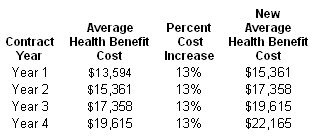
We will address the pension issue in a separate post.
Labels: New Jersey, State Budget, State Budget 2008, State Worker Benefits, Union Contract
Posted by Enlighten-NewJersey @ 8:31 AM
|
New Jersey State Budget 2008
Corzine’s 2008 budget calls for a 7.2 increase in spending, from $31.061billion in 2007 to $33.292 billion for 2008.
Corzine estimates state revenue from taxes and fess will generate $31.952 billion in 2008 - $1.34 billion less than his proposed spending for the year. This budget gap is to be financed with $665 million from the non-recurring use of the dedicated FY 2007 half penny from the sales tax increase and a $670 million non-recurring surplus as a result of stronger than anticipated FY 2007 revenues.
Corzine estimates a $2.5 billion budget deficit for 2009 - with state spending of $35.4 billion and revenues of $32.9 billion.
Labels: New Jersey, State Budget, State Budget 2008
Posted by Enlighten-NewJersey @ 2:18 PM
|
Report of the Benefits Task Force – Part 1
"Tax increases of sufficient dimension to deal with our looming fiscal problems arguably pose significant risks to economic growth and the revenue base," he said, reiterating his conviction that the government should seek to "close the fiscal gap primarily, if not wholly, from the outlay side."Acting Governor Codey confronted similar issues in the preparation of New Jersey’s budget last winter. “Each year the state's fixed costs grow larger and larger and consume more and more of the budget. This is an issue we can no longer ignore.”
Faced with the unsustainable growth in the cost of healthcare and pension benefits for state and local government workers, Codey established a Benefits Review Task Force to recommend ways to reverse this trend.
Yesterday the New Jersey Report of the Benefits Review Task Force was released. The task force concluded:
The current process for reviewing benefits is haphazard at best and excessively influenced by political instead of fiscal motivations. The non-stop requests (and too often action) for legislative action have eroded the state’s fiscal health and created a benefit structure that the State cannot currently afford.Unfortunately, the record remains unbroken as the interests of taxpayers are virtually absent from task force recommendations. The task force apparently was prevented by certain members from using the private sector for comparison purposes and from recommending major changes to benefit structures. Further, the task force did not study other “fringe benefits totaling approximately $5.2 billion annually” as it was not within the scope of their charge.
The benefit enhancement process far too frequently happens in the complete absence of an informed debate on the actual costs of the change, yet alone how it will be paid for over the long term. And far too often, the taxpayer’s interests are absent.
There are differences between the public and private sectors that complicate a pure comparison between the two. The Task Force spent a great deal of time comparing and debating public versus private sector compensation structures. At the end, we agreed to disagree.While the task force specifically concludes New Jersey has “a benefit structure that the State cannot currently afford”, the group ultimately recommends this structure be maintained. The task force recommends changes around the margins and avoids those that would result in major long–term savings to taxpayers:
The Task Force attempted to ensure that every stakeholder contributed toward solving the problem, without unduly burdening any particular group. For reasons explained below, we rejected a massive structural change such as a move to a defined contribution plan. Instead, we made more targeted strategic reforms designed to maintain the current systems with modifications.
Increase the retirement age from 55 to 60To sure up the pension funds the task force recommends:
Base pensions on the highest five years of salaries rather than the highest three years and in cases where pensions are based on highest single year use highest 3 years
Increase the minimum annual salary for inclusion in the pension system from $1,500 to $5,000
Put an end to pension tacking, padding and boosting and end early retirement incentives
Employees should no longer be permitted to take loans against their pension fund contributions as employees have been charged less than half of the state required rate of return
Revisit legislation that provided parameters for simultaneously receiving a public pension and a full public salary
Implement the state’s cap on sick day payouts of $15,000 to local government levels
End pensions for non-government employees and public officials convicted of crimes
Offer elected and appointed individuals a defined contribution (401k style) plan rather than the currently offered defined benefit plan
Retirees and current employees should contribute toward the cost of health insurance – at least 5%
Reduce prescription drug costs by: contracting directly with a Pharmacy Benefit Manager (PBM)*; encourage greater generic drug utilization; require mandatory mail-order for maintenance prescriptions
Immediately apply health care benefits changes negotiated by the State in the last contract to local employers and employees, consistent with historical practice
Provide greater health insurance options for local negotiations
Revamp governance process for benefit enhancements
Use consistent and generally accepted actuarial standards to determine pension fund asset values, obligations and annual contributions
Immediately reduce the Defined Benefits Plans’ [pension funds] $12.1 Billion deficiency by selling state assetsUnbelievably, a task force charged with reducing the escalating costs of government employee benefits couldn’t resist recommending benefit enhancements themselves:
In the future make annual full, actuarially sound pension payments
Change vesting from 10 years to five (5) years. Lower the vesting requirements from 10 years to five (5) years. The vesting requirement reflects the years of service credit in the retirement system necessary for the employee to be entitled to future retirement benefits.While the Task Force acknowledges “early retirement incentives have provided limited, short-term savings in exchange for large, long-term retirement system liabilities”, they now suggest the introduction of severance packages.
While the Task Force considered that if vesting were to remain at 10 years it would prevent more pension liabilities, it considers the cost of lowering the requirement to five (5) years to be minimal.
To avoid a “brain drain” the task force foresees “programs to encourage older employees to continue to work may be necessary.” And finally the group recommends the state “offer a life-long survivors benefit.”
* We had to laugh when we read this recommendation – this is the service Doug Forrester’s BeneCard business provides. It was constantly denigrated by Democrats, especially Jon Corzine in the governor’s race last month.
Labels: State Budget, State Worker Benefits, State Worker Union Contract
Posted by Enlighten-NewJersey @ 6:10 PM
|
Codey Keeps Options Open With $4 Billion Deficit
As Codey pondered his moves, state Treasurer John E. McCormac reported Dec.17 that all state revenue collections for the first five months this year totaled $9.6 billion, 1.9 percent below projections. If the revenue picture remains discouraging, Codey could be forced into a number of drastic moves, unwelcome in an election year when both the governor's office and control of the Assembly are at stake. Democrats now control the Assembly, 47-33, but tax hikes, layoffs or aid reductions could prove so unpopular that the Republicans could win the eight seats they need to take back control.
Oddly enough, however, that gloomy forecast could have a silver lining for U.S. Sen. Jon Corzine, of Hoboken, the favorite for the Democratic gubernatorial nomination in next June's primary election. Corzine could bankroll his own campaign out of his well-lined pockets and therefore run as an "outsider," making him immune from any voter backlash against Democratic budget practices or tax increases. More here.
We suggest Acting Governor Codey cut spending to achieve a balanced budget. He might start with the wasteful spending we’ve highlighted in the past month or so in this blog. And he should continue cutting by eliminating all nonessential programs immediately.
Budget gimmicks, new or increased taxes are not acceptable. Further, an unsolved budget crisis is not a sliver lining for Jon Corzine. – a liberal U.S. Senator that has opposed federal income tax cuts that are most beneficial to New Jersey taxpayers. Corzine’s philosophy of bigger and “better” spending programs coupled with ever higher taxes is not a solution New Jersey voters will buy in 2005.
Labels: New Jersey, State Budget, State Budget 2006
Posted by Enlighten-NewJersey @ 1:17 PM
|